Pathfinder
This is a Southern Water Project to reduce storm overflows that can result in diluted sewage being discharged into our rivers and seas.
The problem
Most of the Island (and country) has a combined sewer system. There are not different pipes for foul and surface water.
During dry weather, flow from domestic and industrial properties is treated at a wastewater treatment works and then released into rivers or the sea. In wet weather, when rain runoff from roads and roofs is combined with wastewater in the sewer, storm tanks are used to hold excess ready to be treated after high flows. For severe storm conditions and once the storm tanks are full, overflows are used to prevent the flooding of homes, businesses, hospitals and schools.
Combined Sewer Outflows (CSOs) are a pressure relief valve for the system to prevent the devastating impact of sewer flooding.

The Storm overflows reduction plan
This plan contains actions for water companies, the Government and the public to help reduce the impact of storm overflow discharges. The plan says:
- by 2035, water companies will have to improve all storm overflows discharging into or near every designated bathing water; and improve 75% of overflows discharging into high priority nature sites
- by 2050, this will apply to all remaining storm overflows covered by our targets, regardless of location
Under the plan, overflows that are causing the most harm will be addressed first, and it will be reviewed in 2027 to see where it can go further.
Southern Water’s response
Southern Water have promised to cut storm releases across their region by 80% by 2030. So they are ahead of targets. To do this they have established a Pathfinder Task Force. This will involve:
- Viewing the water system holistically
- Establish strong partnership approaches to deliver interventions
- Prioritising sustainable catchment and nature-based solutions
- Build a regional plan for implementation between now and 2030
Their research has shown that discharges are over 95% rainwater, of this, 30% of flow comes from roads, 40% comes from roofs and 15% comes from gardens and open spaces. If they remove 40% of the stormwater, they can reduce CSO discharges by 80%.
The Pathfinder projects has pilots across the region including the Isle of Wight.
Pathfinder Isle of Wight
This consists of a number of elements.
Getting their own sites in order
Basically, making sure the pumps work to their optimum potential, making sure alarms work correctly, increasing storm storage and making sure rainwater falling on their own sites isn’t going into the CS.
Tackling Connectivity

Surface and storm water do not need to be treated, therefore if it can be removed from the CS system it should be. Are large rooves or other large impermeable areas flowing into drainage? Often, it’s not apparent to the business owner or householder, so Southern Water will offer free connectivity surveys.
And then slowing the flow
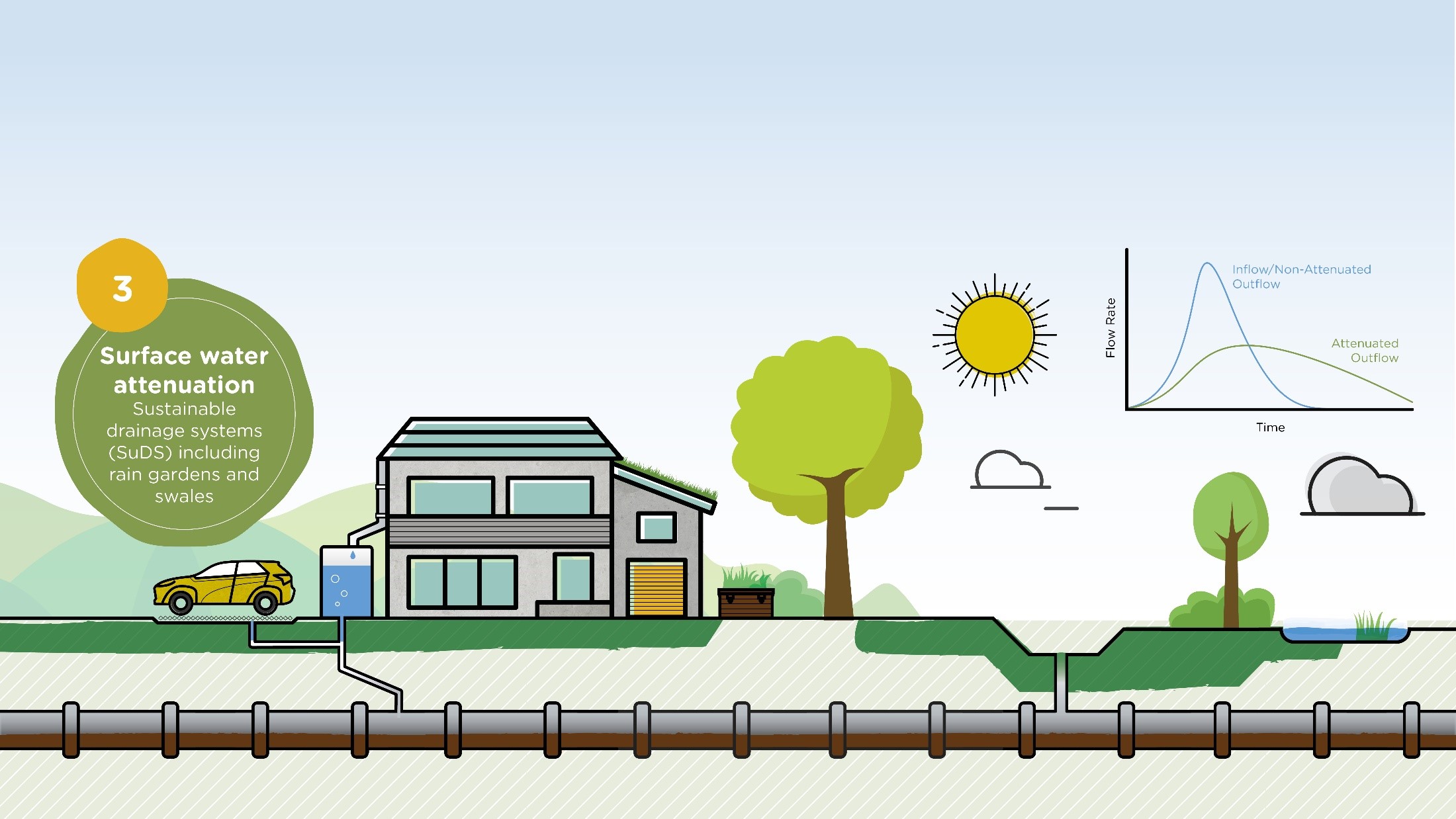
Using feature such as SuDS to ‘connected’ rainwater harvesting in our urban areas, as well as upstream, we can mimic natural water management. Many small changes can have a big combined effect on reducing flood water quantity and improves our urban and natural environment
Property Sustainable Urban Drainage Systems (SuDS)

These can be smart water butts (quite expensive!), slow-drain normal ones, soak aways or rain gardens. Not all properties or underlying geology are suitable. Southern Water will work with owners and tenants to see whether this can work.
Highway drainage and public estate

Working with Island Roads and Isle of Wight Council to identify opportunities for rain gardens and swales in our streets and on IW Council property.
Initial pilot project for slowing the flow
Havenstreet was selected as it was small and easy to monitor results. One pumping station discharged to Blackbridge Brook, which flows through a Site of Special Scientific Interest classed as ‘failing’. In storms capacity was exceeded by 50% which meant that on average there were about 20 releases per annum.
There are 184 households within the catchment. All of these were offered slow drain water butts and 6 non-household properties with large impermeable roof areas were offered SuDs planters. There were 132 take-ups. Additionally, a highways misconnection was diverted to a swale.
This took place between August and October 2022. At the time of writing this page (December 2022) there has not been a pumping station discharge despite extreme rain events.
The project is now moving to the Cowes area which is aa much larger challenge. Southern Water are identifying where the issues and opportunities are within the town.
To find out more
This Southern Water report is worth a read.